Free Software Download Center
Software for industrial data collection, monitoring, and analysis.
ADVANCED GRAPHICS • INDUSTRIAL SHAPES • PARAMETRIC DESIGN
EOS SCADA software provides numerous user control object engines, thousands of industrial shapes in vector format, and parameterized settings for user control objects to create sophisticated visual and interactive designs.
Below is a list of the user control engines available in EOS SCADA, along with brief descriptions of these engines.

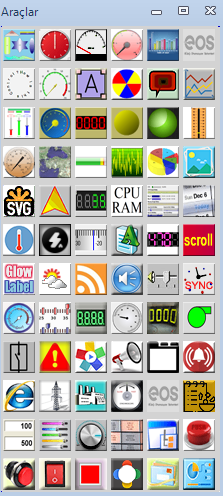
The user control engines used in the EOS SCADA Editor make it possible to design operator screens not only with basic graphics, but also with advanced visual and audio objects that can be associated with data.
These engines can be used to create displays, buttons, alarm objects, charts, text elements, animations, navigation components, industrial shapes, and specialized control panels. The created user controls can then be saved as templates and reused on different SCADA screens.
Total number of engines: 71 • The list covers the user control engines available in the EOS SCADA design infrastructure.
| Engine Name | Engine Symbol | Engine Description |
|---|---|---|
|
UC_ADVANCED_PB (CETVELLIGOSTERGE) |
An engine that can be used to create ruler-based linear indicator templates in many different shapes, such as rectangles, triangles, circles, ellipses, and sectional forms, with different fill options. The ruler can be configured independently from the linear indicator. The fill direction can be set to vertical or horizontal. | |
|
UC_ALARM_INDICATOR (ALARMINDICATOR) |
An engine developed to create alarm indicator templates in different shapes such as triangles, squares, circles, and hexagons. The active alarm count can be positioned anywhere within the warning indicator. | |
|
UC_SYNCHROSCOPE (SYNCHROSCOPE) |
An engine that provides a synchroscope visualization according to the data to which it is connected. It also includes an animation feature for use when no data is connected. | |
|
UC_ALARMLISTESI (ALARMLISTESI) |
A user control designed to add alarm list functionality to SCADA pages. It can operate in different modes, such as continuous display, active alarms only, and acknowledgment. The alarm information displayed in the table and the visual properties of the table can also be customized by the user to match the screen design. | |
|
UC_ANALOG_CLOCK (ANALOGSAAT) |
A clock engine designed to add three different realistic analog clock designs to SCADA pages. The clock designs can be extensively customized by the end user. | |
|
UC_ANALOG_METER (ANALOGGOSTERGE) |
An engine designed to add traditional analog indicators with classic features to SCADA pages. Details on the indicators, scales and scale ranges, labels, and indicator needles can be customized by the end user. | |
|
UC_ANNUNCIATOR (ANNUNCIATOR) |
A user control engine developed to create signal panels in different shapes, such as squares, triangles, and circles, with a wide range of visual properties. It supports four lines of signal messages. It can change color according to the connected signals and can also send commands to the controller when clicked. | |
|
UC_AQUA_GOSTERGE (AQUAGOSTERGE) |
A user control engine added to the design environment for creating circular indicators with a glass-like appearance. Many properties, including color, needle thickness and color, and scale ranges, can be customized. | |
|
UC_BAR_CHART (BARCHART) |
A user control engine developed to add live bar charts to SCADA pages, with many customizable features. | |
|
UC_BULLET_GRAPH (BULLETGRAPH) |
An engine developed to create user control templates that can display multiple data values simultaneously for comparison on a linear scale. | |
|
UC_CIRCULAR_FRAME (CIRCULARFRAME) |
This engine makes it possible to create professional-looking circular indicators in many different styles. Almost every detail of the circular indicator can be configured according to user preferences. Although the design stage requires some effort, once the user controls have been designed, they can be added to the template library and reused on different SCADA pages. | |
|
UC_CUSTOMTEXT (SEKILLIGOSTERGE) |
This engine makes it possible to create visually distinctive text elements that can take forms such as circles and rings and can be connected to SCADA data. Plain text can also be displayed at different angles. | |
|
UC_DAIResel_GOSTERGE (DAIRESELGOSTERGE) |
This engine can be used to create quarter-circle, half-circle, and full-circle indicators. Scale zones can be created within the indicator, and all indicator properties can be customized by the user. | |
|
UC_DATA_BOX (DATABOX) |
The Databox engine allows text areas to be created for sending data to SCADA. It enables the design of user controls in which data to be sent to SCADA can be entered into a text box using the keyboard and then sent to the automation system as a command by clicking the Apply button. | |
|
UC_DUYURUPANELI (DUYURUPANELI) |
The announcement panel provides an environment for publishing announcements such as occupational health and safety notices, marriage announcements, birth announcements, and special-day messages on SCADA pages. Many properties of the announcement panel can be customized by the user. Announcements are stored in a separate Firebird database. A separate announcement management software is available for modifying announcements. | |
|
UC_ETIKET (ETIKET) |
This advanced label engine allows user control templates to be created using a three-part combination of 1) data header, 2) value, and 3) unit. All components can be customized individually, making it possible to create visually effective label components for presenting data on SCADA screens. | |
|
UC_MASTER_NAV (MASTERNAVIGATOR) |
This engine provides an EOS SCADA-specific tool for combining prepared SCADA screens under a single menu. SCADA pages can be organized under a tree structure, toolbar, or automatic navigation arrangement, including title, menu, and alarm sections. To access the SCADA screens, the user only needs to open the page containing the Master Navigator and use the navigation functions on that page. | |
|
UC_EXTRA_SHAPES (RENKLIGOSTERGE) |
An extra-shape engine for creating various graphical shapes such as rectangles, squares, ellipses, and triangles. Many properties, including the fill color, fill pattern, and border line, can be customized by the end user. Data can also be bound to this user control. | |
|
UC_PIPES_MOTORS (BORUVEMOTOR) |
This engine allows the user to create user controls containing animated pipe and motor elements. Flow and movement directions, pipe styles and angles, flow styles, and all color settings can be customized. Pipe flow and motor rotation speeds can also be configured to change according to the SCADA value being read. | |
|
UC_GLABEL (GLABEL) |
This engine makes it possible to create visually distinctive text user controls that can receive three levels of text and color values according to the variable read by SCADA and whose many properties can be customized. Effects such as glow, feathering, color gradients, border boxes, shadows, and heartbeat effects can be added to the text, some fixed and some animated. | |
|
UC_GRAFIK (CANLIGRAFIK) |
This engine was created to design user controls containing live bar charts for SCADA pages. The user can modify many properties of the chart object and configure it according to the desired design. | |
|
UC_GTRACKBAR (DOGRUSALGOSTERGE) |
An engine designed to create linear indicators. The resulting linear indicators can be horizontal or vertical, and many of their properties can be customized by the user. | |
|
UC_GUPDATA (GUPDATA) |
This user control was developed to meet the needs of EÜAŞ facilities. It can display the facility's Day-Ahead Market (DAM) obligations and actual values comparatively on the SCADA page. If the obligation has been met, a green warning light is displayed for that hour; if it has not been met, a red warning light is displayed. This makes it easier for operators to monitor their DAM obligations. | |
|
UC_HAVA_DURUMU (HAVADURUMU) |
This user control engine allows weather conditions for different cities in Türkiye to be displayed on SCADA pages either statically or cyclically. The user control reads temperature values at predefined intervals from the General Directorate of Meteorology pages. It can display the temperature values for a selected city statically or cyclically display the temperature values for all cities read from the source. Weather conditions can be presented using a visual element such as sunny, rainy, or snowy, together with the expected maximum and minimum temperatures. | |
|
UC_HORIZONTAL_FRAME (HORIZONTALFRAME) |
This engine makes it possible to create professional-looking horizontal indicators in many different styles. Almost every detail of the horizontal indicator can be configured according to user preferences. Although the design stage requires some effort, once the user controls have been designed, they can be added to the template library and easily reused on different SCADA pages. | |
|
UC_INDUSTRIAL_LED (INDUSTRIALLED) |
This engine makes it possible to use thousands of industrial shapes in vector format as industrial LEDs and create thousands of different user controls. For example, the user can add a pump shape in vector format to the page and associate it with SCADA data. Depending on the value of the SCADA data, the pump can change color or shape, or transition to a different visual representation. The engine also allows graphical objects to be imported externally. Many properties can be customized according to the end user's requirements. | |
|
UC_INTERNET_TARAYICISI (INTERNETTARAYICISI) |
This engine makes it possible to embed an Internet page into a SCADA page. The Internet page supports two-stage page loading. | |
|
UC_KAYAR_GOSTERGE (KAYARGOSTERGE) |
An engine that can be used to add traditional analog horizontal and vertical sliding indicators. The color of the sliding component, scale ranges, and indicator needle properties can be configured by the user. | |
|
UC_KESICI (KESICIDURUM) |
This engine allows the user to design breakers and disconnectors that can also send command data to SCADA. The color properties, line thickness, and shape angle of the breaker and disconnector can be configured. In addition, the status menu opened by right-clicking allows breaker Open or Close commands to be sent from SCADA to the controller. | |
|
UC_KNOB (KNOB) |
This engine helps create professional-looking rotary buttons. The created buttons can send commands to the controller through SCADA. The user can customize many properties of the created button. | |
|
UC_LABEL_GRADIENT (BASITGOSTERGE) |
This engine is designed to create different types of text boxes, including shadowed, gradient, and simple styles. SCADA data can be bound to the text boxes and used to visualize SCADA data. | |
|
UC_LB_GOSTERGE (LBGOSTERGE) |
An engine designed to create circular indicators supporting many customizable features, including dial and needle colors, scale lines and ranges, and color zones. | |
|
UC_LB_LED (LBLED) |
Designed to create user-configurable "text LED lights" in adjustable sizes. The user can bind the LED light to any desired SCADA data and create multi-level variations for the LED. It can be configured as a flashing warning alarm when a specified alarm value is exceeded. The LED's color and status can change according to SCADA data, and the text corresponding to these states can also be modified. | |
|
UC_LBBASIT_GOSTERGE (LBBASITGOSTERGE) |
This numerical indicator engine can be used to create "LED numerical" displays in many different designs, with a flashing feature when a specified threshold is exceeded. | |
|
UC_LED_CONTROL (LEDCONTROL) |
This "LED numerical" indicator engine includes a "Fast Graph" feature and can be used to create many different LED numerical display designs. When "Fast Graph" is enabled, clicking the mini button that appears in the corner of the indicator quickly visualizes the historical data for the configured period as a chart, opening a window displaying the line chart of the SCADA data for that time interval. | |
|
UC_LEDBULB (LEDBULB) |
An engine that can be used to create four different types of LED lights: elliptical, square, diamond, and 3D. It enables the creation of alarm-enabled user controls with two-state, three-state, and flashing features. It also includes an audible warning feature. | |
|
UC_MACTRACKBAR (MACTRACKBAR) |
An engine that can be used to design horizontal and vertical linear indicators. The needle can be circular or rectangular. A scale ruler can be added to one side or both sides of the indicator. The color of scale points and labels can be configured. | |
|
UC_MANOMETER (MANOMETER) |
An engine designed to create professional-looking circular indicators. The indicator can be configured to operate clockwise or counterclockwise. Descriptive text can be placed on the indicator dial. The shape and color of scale lines and the indicator needle can be configured. The indicator can store the highest value it has received. | |
|
UC_MAP (HARITA) |
A user control engine designed to place a map with coordinates entered by the user on the SCADA screen. Because the map data is downloaded over the Internet, the SCADA computer must be connected to the Internet for this user control to operate properly. | |
|
UC_NEROBAR (NEROBAR) |
This engine was created to present data read from SCADA comparatively on a ruler-based horizontal indicator. It allows horizontal data zones to be created and displays the current value on the indicator dial. The engine also allows visual effects such as glow to be added to the horizontal indicator. | |
|
UC_NUMERICAL_FRAME (NUMERICALFRAME) |
This engine makes it possible to create professional-looking numerical indicators in many different styles. Almost every detail of the numerical indicator can be configured according to user preferences. Although the design stage requires some effort, once the user controls have been designed, they can be added to the template library and easily reused on different SCADA pages. | |
|
UC_OSG_NUMERIC (OSGNUMERIC) |
An engine designed to create numerical indicators. The user can customize many properties of the indicator, including the number of decimal places. | |
|
UC_OSG_ROUND (OSGROUND) |
This engine helps users create circular indicator templates. Many indicator-related properties can be modified by the end user. | |
|
UC_PERF_MONITOR (PERFMONITOR) |
This engine helps users create performance monitoring panels that can be connected to SCADA data. Many properties, including the background color, grid, and graph lines of the performance panel, can be customized by the user. It can be configured to use relative and absolute charts. | |
|
UC_PFKANALYSIS (PFKANALYSIS) |
This user control was developed to evaluate the ancillary services performance of facilities in real time using ancillary services data collected at EÜAŞ facilities. The ancillary services performance can be displayed instantaneously using the collected data. | |
|
UC_PIE_CHART (PIECHART) |
A user control engine developed to add live pie charts to SCADA pages, with many customizable features. | |
|
UC_PUSH_BUTTON (PUSHBUTTON) |
This engine was developed to create push-button templates with different visual properties. The resulting buttons can be circular, elliptical, or rectangular. Text can be added with 3D effects, and the colors for normal and pressed states can be configured. The push button is primarily designed to send command data to the controller. | |
|
UC_TACT_BUTTON (TACTBUTTON) |
This engine was developed to create tact button templates with different visual properties. The resulting buttons can be circular, elliptical, or rectangular. Text can be added with 3D effects, and the colors for normal and pressed states can be configured. The tact button is primarily designed to send command data to the controller. | |
|
UC_SWITCH_BUTTON (SWITCHBUTTON) |
An engine developed to create user control templates with different visual characteristics, such as rocker, toggle, LED, lever, rotary, and panel buttons. Many properties of the buttons can be configured according to the design, and the buttons can also be rotated to a specific angle. The Open/Closed state texts can be changed. This button type is primarily designed to send command data to the controller. | |
|
UC_STND_BUTTON (STNDBUTTON) |
An engine added to the design environment to use the standard button user control provided by the Windows Framework in SCADA screens. It can be configured as either a Push or Tact button. Background images, colors, and text values can also be assigned to the button for both normal and pressed states. This button type is primarily designed to send command data to the controller. | |
|
UC_NAV_BUTTON (NAVBUTTON) |
The navigation button engine is designed to add navigation functionality to SCADA screens. These buttons can perform operations such as opening a new screen and closing the current screen. Different button options are available, including a label, image box, circular image box, circular button, and virtual data selection button. Normal and pressed-state colors can also be assigned to the button. | |
|
UC_PICT_BUTTON (PICTBUTTON) |
The image button engine is designed to create image-based normal and circular buttons. It can be configured as either a Push or Tact button. Background images, colors, and text values can also be assigned to the button for both normal and pressed states. This button type is primarily designed to send command data to the controller. | |
|
UC_RESIM (RESIM) |
The image engine is designed to add static and animated visual elements to SCADA screens. All visual frames that make up an animation can be added to a user control through this engine. The animation starts when the connected SCADA data exceeds a specified threshold and stops when it falls below that threshold. This type of user control allows the animation speed to be adjusted and dynamic animations to be created according to the data value. It can also be used simply to add a static visual element to a SCADA screen. | |
|
UC_RSS_HABER (RSSHABER) |
The RSS control engine allows current news, company news, weather information, and other RSS sources to be displayed on a SCADA screen. Three different RSS sources can be combined under a single control. RSS data is displayed as scrolling text. News feed and refresh intervals can be configured by the user. | |
|
UC_SCROLLING_TEXT (SCROLLINGTEXT) |
This engine makes it possible to create scrolling text moving from left to right or right to left and integrate the text with SCADA data. It is also possible to display all SCADA data sequentially as scrolling text. Many properties related to scrolling text can be configured by the end user. | |
|
UC_SES (UYARISES) |
Using audible alerts, hourly alarms, call-to-prayer alarms, single- and double-hour alarms, single- and double-level alarms, and customized audible alarms can be added to SCADA pages. Before and after announcement text audio files can be added for each announcement. SCADA data can also be announced audibly. | |
|
UC_SESKONTROL (SESKONTROL) |
This engine allows volume-up, volume-down, and mute controls to be added to a SCADA screen. | |
|
UC_SHAPE (SEKIL) |
This engine allows a wide variety of shapes with different properties to be added to SCADA screens. Available shapes include squares, rectangles, triangles, circles, ellipses, diamonds, rounded rectangles, balloons, and polygons. These shapes can be added to SCADA pages with configurable lines, interior colors, fills, and gradient color regions. | |
|
UC_SLIDER (SLIDER) |
This engine was created to produce horizontal and vertical linear indicators capable of sending commands to the controller. The slider can be configured as a slider, three-state switch, or switch slider. The scale levels of sliders and switches can be adjusted by the end user. This button type is primarily designed to send command data to the controller. | |
|
UC_SLIDESHOW (SLIDESHOW) |
This engine allows users to add slideshows with animated transition effects using different images on SCADA screens. Since the images used in the slideshow are stored in a folder under the SCADA folder, the user can modify these images and add new ones at any time. | |
|
UC_SSD_GOSTERGE (SSDGOSTERGE) |
This component is another numerical indicator engine that allows users to create two different visual types of numerical indicators. Many properties of the numerical indicator can be customized by the end user. When the "Fast Graph" feature is enabled, clicking the mini button that appears in the corner of the indicator quickly visualizes the historical data for the configured period as a chart, opening a window displaying the line chart of the SCADA data for that time interval. | |
|
UC_SYSTEM_INFO (SYSTEMINFO) |
This engine was developed to add system information to SCADA screens. CPU and memory usage and hard-disk utilization can be displayed on SCADA screens using this indicator. | |
|
UC_SYSTEM_MONITOR (SYSTEMMONITOR) |
Information such as the computer model, processor type, CPU usage, CPU usage history, active user, memory usage, disk read/write history, and Internet usage can be displayed on SCADA screens using this engine. | |
|
UC_TABCONTROL (TABCONTROL) |
This engine was added to the design environment to organize user controls placed on the screen under a TAB structure. The added TAB control can be customized by the end user in terms of appearance. Since the TAB structure supports only one level, additional TAB controls should not be placed inside a TAB. | |
|
UC_TARIH_SAAT (TARIHSAAT) |
This engine was developed to create user control templates capable of displaying time and date information in different formats on SCADA screens. The user can design separate date and time controls in various formats, including single-line, double-line, and numerical formats, as well as combined date/time user controls. | |
|
UC_NEW_INDUSTRIAL (NEWINDUSTRIAL) |
An engine that can be used to design linear indicators with different visual characteristics, such as thermometers, linear indicators, tank sections, indicator tubes, and LED indicators. The user can create different scale zones and assign colors to these zones. The scale ruler can be configured as desired, and an angle can also be applied to the created indicator. | |
|
UC_TIME_SYNC (TIMESYNC) |
This engine is designed to add time synchronization functionality to SCADA screens. It can synchronize time from GPS, NTP, RECF867, RCF868, and WEB time servers. The end user can configure the time synchronization intervals. It can also perform precise time synchronization using the NMEA protocol from a GPS antenna connected through a serial port, and supports GPS-NTP combo operation. | |
|
UC_RECIPE_MANAGER (RECIPEMANAGER) |
This engine consists of tables used to summarize relevant data such as recipes, machine configurations, or production data. These data can then be rapidly transferred from the operator panel to the controller in a single step, for example when switching production to a different product type. Using this engine, the user can create recipe tables and transfer a group of SCADA parameters that need to be changed to the controller with a single button press. This control type is primarily designed to send group command data to the controller. | |
|
UC_SVG_MACHINE (SVGMACHINE) |
This engine makes it possible to create user controls containing vector-based SVG shapes. For example, the user can add a pump shape in vector format to the page and associate it with SCADA data. Depending on the value of the SCADA data, the pump can change color and shape. The engine also allows graphical objects to be imported externally in SVG format. Many properties can be customized according to the end user's requirements. | |
|
UC_FORCE_MACHINE (FORCEMACHINE) |
This engine is designed to automatically send commands to the controller according to the value of the data being read or according to a specific time schedule. | |
|
UC_PANELPC_NAV (PANELPCNAVIGATOR) |
This engine provides an EOS SCADA-specific tool for combining SCADA screens under a single menu, particularly on Panel PCs prepared for local controllers. SCADA pages can be organized under a tree structure or toolbar arrangement, including menu sections that automatically hide when not in use. To access the SCADA screens, the user only needs to open the page containing the Panel PC Navigator and use the navigation functions on that page. |
After selecting a user control engine in the EOS SCADA Editor, a user control suitable for the screen design can be created using the engine's parametric features. The created control can be connected to the required SCADA data to visualize real-time values, states, or commands.
After the user control design has been completed, the control can be added to the user library as a template. This allows the same design to be reused on different screens and makes it easier to maintain visual standards in large SCADA projects.
Free Software Download Center
Software for industrial data collection, monitoring, and analysis.

Technical Support
Software documentation, sample code, and practical technical information.
You can contact us regarding EOS software, technical documentation, or industrial data communication.