
Free Software Download Center
Software for industrial data collection, monitoring, and analysis.
MOTOR TOOLBAR AND QUICK ACCESS LIBRARY
The User Controls Quick Access Library is available in the EOS SCADA Editor to allow frequently used user control objects to be added to designs quickly and easily.
With this library, previously created and completed user control objects can be reused on different SCADA screens without having to recreate them each time. This can significantly accelerate the screen design process, especially in large projects.
The User Control Engine provides access to the user control engines supported by EOS and facilitates the creation of new user control objects.
The following sections explain how to first add a new user control to a screen using the User Control Engine, then save this control as a template in the Quick Access Library, and finally add the prepared template to other screens through the library.

To provide users with faster access to frequently used user control objects, the User Control Engine button is initially hidden on the Quick Access Button Bar within the EOS SCADA Editor.
To make this button visible, first click on an empty area of any screen design window, and then press the Control-A key combination on the keyboard.
When this operation is performed, the
User Control Engine button
 becomes visible on the Quick Access Button Bar. By clicking this button, the user can
open a selection panel containing a visual list of the user control engines supported
by EOS SCADA.
becomes visible on the Quick Access Button Bar. By clicking this button, the user can
open a selection panel containing a visual list of the user control engines supported
by EOS SCADA.
Usage:
Click on an empty area of the screen design area and then press
Control-A. The User Control Engine button
will become visible on the Quick Access Button Bar.
When the User Control Engine button on the Quick Access Button Bar is clicked, a selection panel opens displaying the user control engines supported by EOS SCADA.
This panel contains visual selection buttons for more than 70 user control engines. Thanks to this visual interface, users can quickly identify the control they need by examining its appearance rather than selecting it based only on its name.
Once the required user control engine has been identified, simply double-click the corresponding visual button. The user control can then be added to the screen design area.
Information: The User Control Engine panel is designed to provide quick access to the user controls supported by EOS SCADA. Users can select the appropriate control engine from this panel according to their requirements.
After selecting the required control engine from the User Control Engine panel, the position where the user control will be placed on the screen is determined.
To do this, navigate to the area of the screen where the user control is to be added,
and then double-click the
 cursor that appears on the screen. As a result, the selected user
control is added to the specified position.
cursor that appears on the screen. As a result, the selected user
control is added to the specified position.
The user control added to the screen can subsequently be moved, resized, and aligned with other screen elements according to the design requirements.
After the user control has been placed on the screen, its properties can be edited, making it ready for use in the SCADA screen.
Operation Summary: Select the desired control from the User Control Engine panel, then double-click the cursor that appears at the position where the control is to be placed on the screen.
After the properties, appearance, and behavior of a user control added to the screen have been configured according to the design requirements, the control can be saved to the Quick Access Template Library.
This allows the same user control to be reused on other screens in the future. As a result, previously completed design work does not need to be recreated.
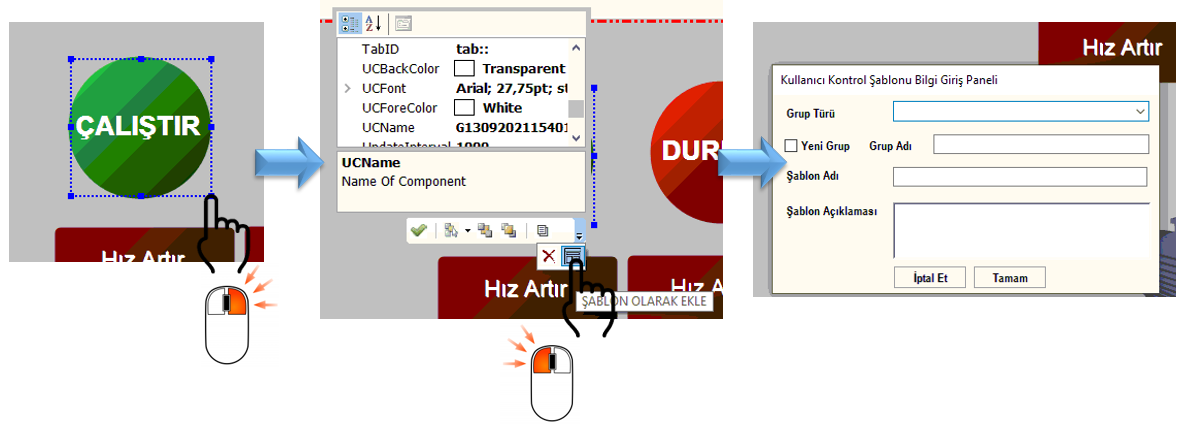
To add the prepared user control to the library as a template, first select the user control on the screen. Then right-click the control to open the corresponding settings window.
In the lower section of the settings window, click the ADD AS TEMPLATE button to add the prepared user control to the Quick Access Template Library.
Important: Before saving a user control as a template, all of its properties and visual arrangement should be fully completed. This ensures that the template added to the library becomes a ready-to-use user control for subsequent designs.
The User Controls Quick Access Library allows previously prepared user control templates to be easily stored, categorized, and reused.
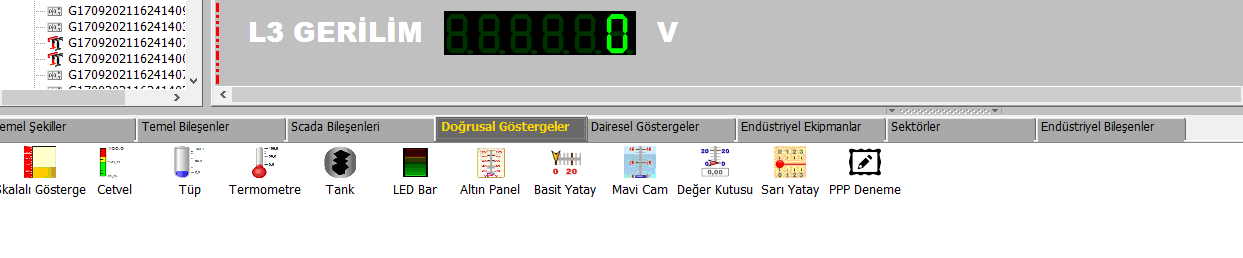
The library consists of group tabs that can be customized by the user. Users can organize their prepared templates into different groups according to their intended use or functions within the project.
This structure makes it easier to find the required control in projects containing a large number of user control templates. It provides significant time savings, particularly for graphical components such as pumps, valves, motors, measurement elements, alarms, and similar objects that are repeatedly used on different screens.
Recommendation: Grouping your prepared templates according to their intended use allows you to find the required user control more quickly within the library.
Adding a previously prepared user control template from the Quick Access Library to a SCADA screen is very straightforward.
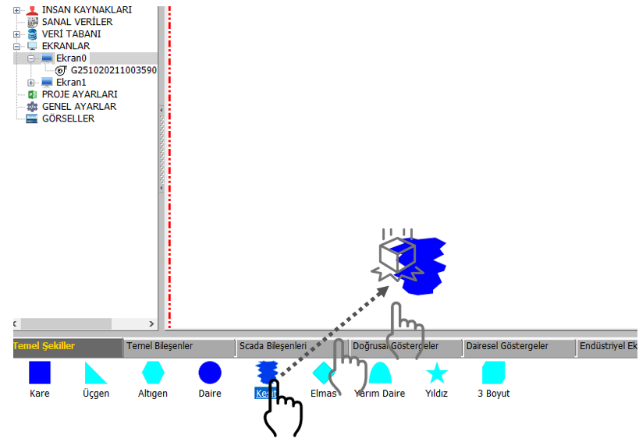
The user can select the desired template in the library with the mouse and drag and drop it into the screen design area.
Once the drag-and-drop operation is completed, the selected user control template is added to the screen. The user can then modify the object's position, size, and required properties according to the design requirements.
This makes it possible to add a previously prepared and tested user control to a new SCADA screen within seconds, without having to recreate it.
Usage: Select the desired user control template from the Quick Access Library and drag and drop it into the screen design area.
The following workflow can be recommended for effective use of user control templates:
The User Controls Quick Access Library helps make the design process faster and more standardized, particularly in SCADA projects containing a large number of screens.
Designing a user control only once and saving it as a template allows the same control to be reused repeatedly on different screens. This approach reduces design time and helps maintain visual consistency between screens.
In addition, the ability to group user-created templates makes it easier to manage the user control library as it grows over time.
Saving reusable user controls as templates in the library reduces unnecessary workload caused by recreating the same design.
Particularly in large SCADA projects containing standardized screen components, effective use of the Quick Access Library contributes to a more organized and sustainable design process.
Within the EOS SCADA Editor, the User Control Engine can be used to select the required control from a large number of available user controls and easily add it to the screen design.
Completed user controls can be saved to the Quick Access Library using the ADD AS TEMPLATE feature. This eliminates the need to recreate a previously prepared user control.
Templates stored in the Quick Access Library can be organized under group tabs created by the user. Users can select the required template from the library and drag and drop it into the screen design area.
This approach accelerates and standardizes user control design, particularly in projects containing a large number of SCADA screens, while enabling previously prepared designs to be reused.
Free Software Download Center
Software for industrial data collection, monitoring, and analysis.

Technical Support
Software documentation, sample code, and practical technical information.
You can contact us regarding EOS software, technical documentation, or industrial data communication.