Free Software Download Center
Software for industrial data collection, monitoring, and analysis.
SCADA • CYBERSECURITY • OT SECURITY • NETWORK MONITORING • CYBER LOG
SCADA software, which forms a central part of industrial automation systems, plays a critical role in monitoring data collected from field devices, controlling processes, and ensuring that plant operations are carried out safely and continuously. As SCADA systems become increasingly integrated with corporate networks, remote access infrastructures, and other information systems, cybersecurity must become an integral part of the SCADA architecture.
Unlike conventional Information Technology (IT) systems, SCADA environments operate in real time and interact directly with physical processes. Therefore, the consequences of a cyberattack may extend beyond data loss or information security breaches and may include more serious operational consequences such as production downtime, equipment damage, degraded process safety, and environmental risks.

Integration between SCADA and cybersecurity software requires multiple layers to be addressed together, including network traffic monitoring, user access control, centralized evaluation of event logs, and securing communications.
Key integration elements:
In EOS SCADA, the relevant project settings must be enabled through the EDITOR software in order to transfer event and alarm information to cybersecurity log records. These settings ensure that events and alarms occurring in the SCADA environment are recorded in a form that can be used in security monitoring processes.
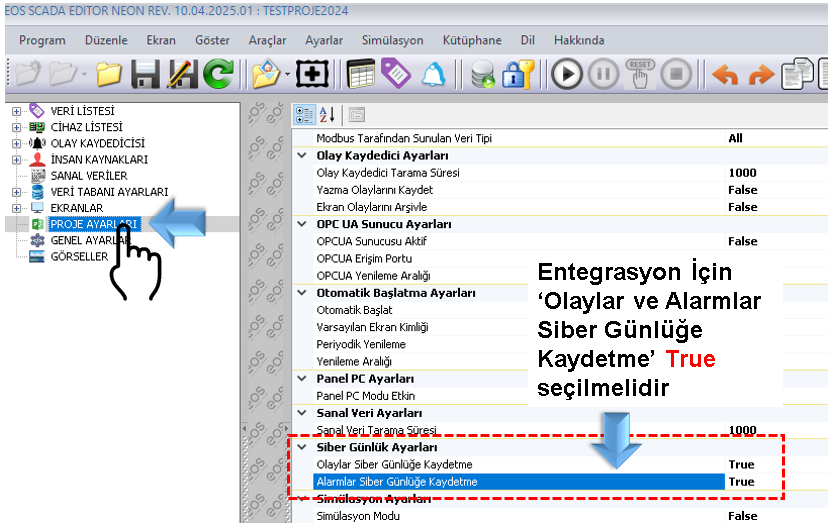
Note: Enabling Cyber Log records is an important configuration step for allowing event and alarm information generated within SCADA to be evaluated as part of security monitoring processes. Transferring and analyzing these records through centralized security solutions depends on the security architecture and integration structures used at the facility.
Maintaining event and alarm records regularly in a SCADA environment is important not only for detecting attacks, but also for retrospective event analysis, evaluating user and system behavior, and analyzing security incidents together with operational processes.
Particularly in critical industrial facilities, cybersecurity and operational safety must be addressed together. Integrating the SCADA system with cybersecurity software provides a stronger defense approach in terms of visibility, traceability, rapid incident response, and operational continuity.
CAUTION: Integration of a SCADA system with cybersecurity software should not be evaluated solely from an information security perspective. When implementing security solutions in industrial environments, real-time operation, process continuity, and the operational requirements of control systems must also be taken into account. Configuration and commissioning activities should be carried out in a controlled manner to ensure that security mechanisms do not adversely affect SCADA communications or critical control functions.
Free Software Download Center
Software for industrial data collection, monitoring, and analysis.

Technical Support
Software documentation, sample code, and practical technical information.
You can contact us regarding EOS software, technical documentation, or industrial data communication.